
Almond Flour: What It Is, How It's Different, and How to Use It
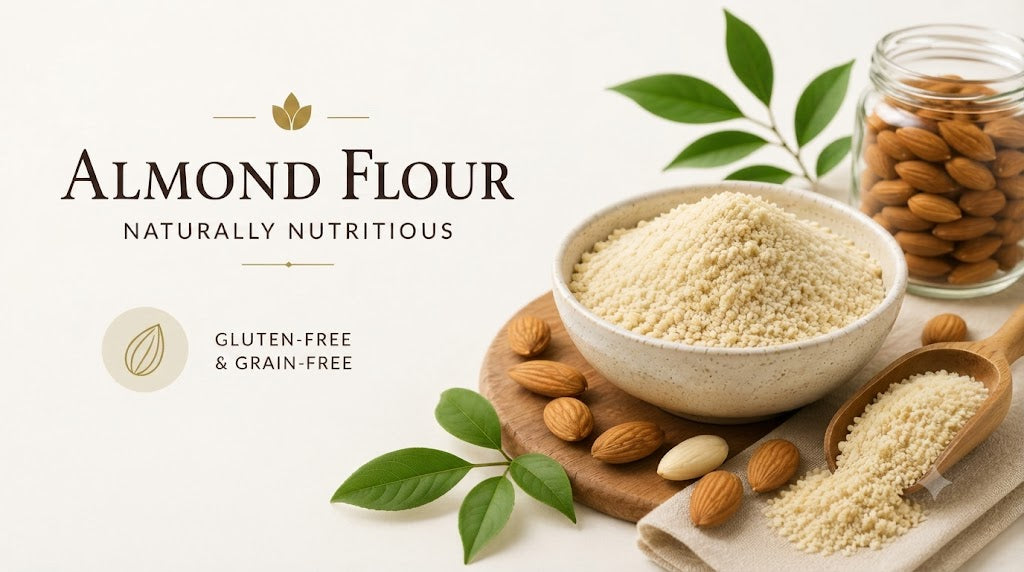
Almond flour has moved from a niche gluten-free substitute to a baking staple in its own right used not just as a wheat replacement but because of the genuinely distinct texture, flavour, and nutritional profile it brings to a recipe.
But almond flour is also one of the more confusing ingredients to shop for, partly because the term is used inconsistently and partly because the substitution ratio into wheat-flour recipes is not a simple 1:1 swap. This guide clears up both issues.
What Is Almond Flour?
Almond flour is made by grinding blanched almonds — almonds with the brown skin removed into a fine powder. The blanching step is what gives true almond flour its pale colour and fine, consistent texture.
It contains no other ingredients: no gluten, no grain, no additives. Nutritionally, it retains almost everything found in whole almonds — protein, fibre, healthy fats, vitamin E, and magnesium — simply in a finely ground, bakeable form.
Almond Flour vs Almond Meal: The Difference That Actually Matters
This is the most common point of confusion when shopping for this ingredient, and the distinction genuinely affects baking results. Almond flour is made from blanched (skin-removed) almonds, ground to a fine, light, relatively uniform texture.
Almond meal is typically made from almonds with the skin still on, ground to a coarser, denser, more rustic texture with visible brown flecks throughout.
For delicate baked goods cakes, macarons, fine pastries almond flour produces a noticeably lighter, more refined crumb. Almond meal works well in heartier applications — crusts, rustic breads, coatings for pan-frying where the coarser texture and slightly more pronounced flavour from the skin are an asset rather than a drawback.
|
|
Almond Flour |
Almond Meal |
|
Made from |
Blanched (skinless) almonds |
Almonds with skin intact |
|
Texture |
Fine, light, uniform |
Coarser, denser, flecked |
|
Colour |
Pale cream |
Speckled brown and cream |
|
Best for |
Cakes, macarons, fine pastries |
Crusts, rustic breads, coatings |
|
Flavour |
Mild, neutral |
More pronounced, slightly bitter edge |
Almond Flour Nutrition (Per 28g / ¼ Cup)
• Calories: ~160 kcal
• Protein: ~6g
• Total carbohydrate: ~6g, of which fibre: ~3g — meaning net carbs of approximately 3g
• Total fat: ~14g, predominantly monounsaturated
• Vitamin E: ~7mg
• Magnesium: ~76mg
This carbohydrate and fibre profile is precisely why almond flour has become central to ketogenic and low-carb baking — its net carb count is a fraction of wheat flour's, which contains approximately 23g of net carbs in the same volume.
How to Make Almond Flour at Home

Almond flour can be made at home two ways. The first: pulse blanched almonds in a food processor in short bursts — 5–10 seconds at a time, scraping down between pulses — until a fine, even powder forms.
Critically, stop before the mixture turns into almond butter; the natural oils release with continued processing, and the moment the texture starts clumping rather than staying powdery, you have gone too far.
The second method makes use of leftover almond pulp from homemade almond milk. Spread the strained pulp thinly on a baking tray and dry in a low oven (around 100°C) for 1.5–2 hours, stirring occasionally, until completely dry and crumbly. Pulse the dried pulp in a food processor to a fine flour consistency.
This method is a genuinely effective way to use what would otherwise be discarded from almond milk preparation.

How to Substitute Almond Flour in Recipes
This is where most home bakers run into trouble. Almond flour cannot simply replace wheat flour in a 1:1 ratio in most recipes, because it contains no gluten the protein structure that gives wheat-based baked goods their rise, structure, and chew. Substituting without adjustment typically produces a dense, flat, overly moist result.
• Direct substitution recipes — many almond flour cookie, cake, and muffin recipes are specifically formulated for almond flour from the start. These work reliably and are the easiest entry point.
• Partial substitution — replacing 25–30% of wheat flour with almond flour in an existing recipe usually works without major structural changes, adding moisture and nutty flavour.
• Full substitution with adjustment — converting a wheat-flour recipe entirely to almond flour typically requires adding extra egg (for binding, replacing the structure gluten would have provided) and reducing other liquid in the recipe, since almond flour is more absorbent of fat but doesn't hydrate in the same way as wheat flour.
• Use a recipe specifically developed for almond flour rather than improvising a full substitution for best results, particularly for bread and any recipe relying on a significant rise.
What Almond Flour Is Good For
• Cookies — produces a tender, slightly dense, chewy result; excellent for shortbread-style cookies.
• Cakes — particularly flourless or low-carb cakes, where almond flour's moisture and richness shine.
• Macarons — the classic French application; almond flour's fine texture is essential to the shell's smooth surface.
• Pancakes and waffles — adds protein and a subtly nutty flavour; works well combined with eggs for structure.
• Pizza and flatbread bases — particularly popular in low-carb and gluten-free cooking, combined with mozzarella and egg for binding (the 'fathead dough' method).
• Breading and coatings — an excellent gluten-free alternative to breadcrumbs for chicken, fish, or vegetables.
Storage

Almond flour has a relatively short shelf life compared to wheat flour due to its fat content, which can turn rancid. Store in an airtight container in the refrigerator for up to 6 months, or in the freezer for up to a year. Always bring to room temperature before using in baking for the most predictable results.
Shop Premium Raw Almonds for Homemade Almond Flour in Hong Kong
At PRESTIGIOUS, our raw almonds are an excellent base for homemade almond flour — additive-free and ready to grind into a fine, fresh flour whenever you need it. Free delivery across Hong Kong on orders over HK$395.
