
How to Make Almond Milk at Home: The Perfect Recipe
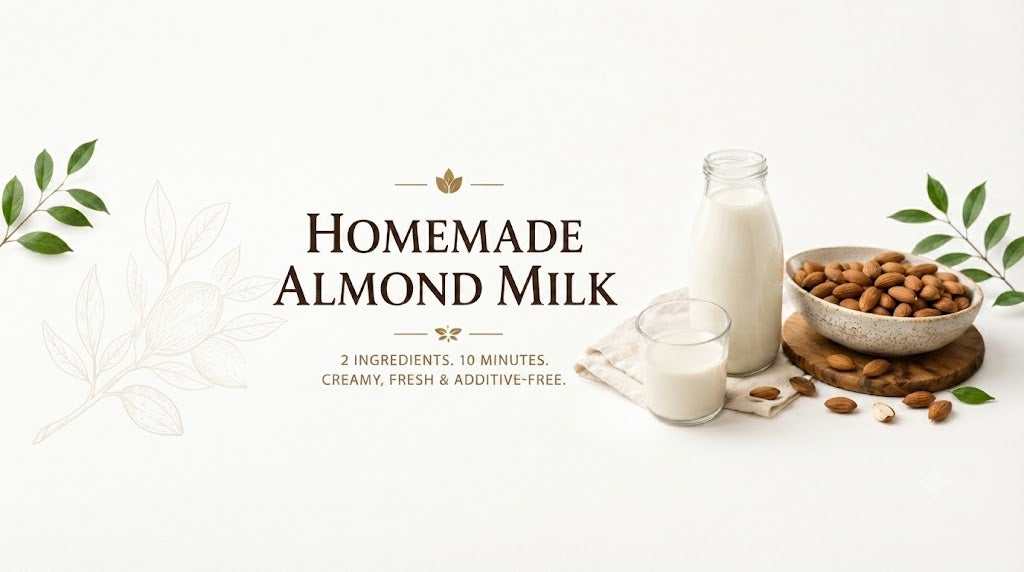
Most commercial almond milk contains less than 2% actual almonds — the rest is water, gums, stabilisers, and often added sugar despite an "unsweetened" label that refers only to the absence of cane sugar, not other sweetening agents.
Making almond milk at home solves this entirely: two ingredients, ten minutes of active time, and a result that is creamier, fresher, and considerably more nutritious than anything in a carton.
This is the version we make and recommend, refined through repeated testing for the ideal ratio and texture.
Why Homemade Almond Milk Is Worth the Effort
Commercial almond milk is, by regulation, mostly water. A typical carton contains roughly 2–4% almonds, with the remaining volume made up of filtered water, thickening gums (such as gellan or locust bean gum), emulsifiers, and often a small amount of added sugar even on "unsweetened" labels referring to flavouring sugar rather than the carrageenan or other additives used for texture.
Homemade almond milk, by contrast, uses a genuinely high ratio of almonds to water, producing a creamier texture and significantly more of the actual nutritional content — protein, vitamin E, and healthy fats — that almonds provide.
The Base Recipe — 2 Ingredients, 10 Minutes Active Time
Ingredients
• 150g raw almonds — soaked (see Step 1)
• 750ml filtered water — for blending
• Optional: pinch of sea salt, 1 teaspoon vanilla extract, or 2 pitted Medjool dates for natural sweetness
Equipment
• A high-powered blender
• A nut milk bag, or a fine cheesecloth, for straining
• A glass bottle or jar with a tight lid for storage
Step-by-Step Method
Step 1 — Soak the Almonds (8–12 hours)

Place 150g raw almonds in a bowl and cover generously with cold water at least double the volume of the almonds. Cover and leave at room temperature, or in the refrigerator in warmer climates, for 8–12 hours, or overnight.
Soaking softens the almonds, making them easier to blend into a smooth milk, and also begins to break down phytic acid a compound that can otherwise reduce mineral absorption. Drain and rinse the soaked almonds thoroughly before proceeding.
Step 2 — Blend (2 minutes)

Add the soaked, drained almonds to a high-powered blender along with 750ml of fresh filtered water. Blend on the highest setting for 90 seconds to 2 minutes, until the mixture is opaque, pale, and fully broken down you should not see any visible almond chunks remaining.
The water-to-almond ratio here (5:1) produces a creamy, full-bodied milk; reduce the water to 600ml for a richer, more concentrated result, or increase to 900ml for a lighter milk.
Step 3 — Strain (3–4 minutes)

Position a nut milk bag (or several layers of cheesecloth) over a large bowl or jug. Pour the blended mixture through slowly, then gather the bag and squeeze firmly from top to bottom to extract as much liquid as possible.
This step requires genuine hand pressure — a gentle pour-through is not enough to extract the full milk yield. You should be left with a smooth, creamy white liquid in the bowl and a dry, crumbly pulp inside the bag.
Step 4 — Flavour and Bottle (1 minute)

Stir in a pinch of sea salt and, if desired, 1 teaspoon of vanilla extract for a classic flavour profile, or blend 2 pitted Medjool dates into the milk at Step 2 for natural sweetness without any refined sugar.
Transfer to a clean glass bottle with a tight-fitting lid. Shake before each use, as natural separation will occur — this is normal and expected with a genuinely additive-free milk.
Storage
• Refrigerator: 4–5 days in a sealed glass bottle. Shake well before each use.
• Do not freeze — the texture separates irreversibly and does not recombine on thawing.
• If the milk develops a sour smell or taste before day 4, discard — without preservatives, homemade almond milk has a genuinely shorter shelf life than the commercial alternative.
Ways to Use Your Homemade Almond Milk
• Coffee and lattes — its natural creaminess holds up well against hot espresso without curdling, provided the milk is fresh.
• Smoothies — adds protein and creaminess without the sweetness of commercial brands.
• Overnight oats — soaks into the oats beautifully overnight, similar to dairy milk.
• Baking — substitutes 1:1 for dairy milk in most cake, pancake, and muffin recipes.
• Cereal — a clean, neutral base that doesn't compete with the cereal's own flavour.
• Golden milk or chai — the natural almond flavour pairs particularly well with warming spices.
Almond Milk vs Cow's Milk: A Quick Comparison
|
|
Homemade Almond Milk (per 240ml) |
Whole Cow's Milk (per 240ml) |
|
Calories |
~60 kcal |
~150 kcal |
|
Protein |
~3g |
~8g |
|
Calcium |
Naturally low — fortify if needed |
~300mg |
|
Saturated fat |
Negligible |
~5g |
|
Vitamin E |
High |
Negligible |
|
Lactose |
None |
Present |
|
Best for |
Dairy-free, plant-based diets |
Higher protein and calcium needs |
Note: homemade almond milk is naturally lower in calcium and protein than dairy milk, since it is not fortified the way most commercial cartons are. If calcium intake is a specific concern, ensure it is met through other dietary sources or supplementation.
Shop Premium Raw Almonds for Homemade Milk in Hong Kong
The quality of your almond milk depends entirely on the quality of your almonds. Our raw almonds — unroasted, unsalted, and free from any treatment — are the ideal base for a clean, additive-free homemade milk. Free delivery across Hong Kong on orders over HK$395.
